The Great Lakes, the world’s largest group of freshwater lakes, are estimated to hold over 20% of the world’s surface freshwater. Spanning across eight US states and two Canadian provinces, their combined shoreline is greater than the US west and east coasts combined. With ocean access via the St Lawrence River in eastern Canada, it didn’t take long for the first European explorers to navigate their way into this massive group of lakes.
Early Exploration and Indigenous Knowledge
The first sailing ships entered Lake Ontario in the 1600s, led by French explorers. However this new body of water came with several challenges, harsh winter storms, complex shorelines and navigational “roadblocks” such as Niagara Falls, keeping the upper Great Lakes inaccessible. At this time, European explorers turned to local Indigenous tribes who had thrived in this environment for millennia. It’s estimated that local Indigenous tribes were navigating the Great Lakes for over 5,000 years with small boats prior to the arrival of the Europeans. These early explorers quickly made allies with the Indigenous populations who shared knowledge and experience to help unlock the Upper Great Lakes.
In the late 1600s, explorer Sieur de La Salle, with the aid of his crew and Indigenous allies, navigated through the wilderness around Niagara Falls on foot and constructed a brand-new sailing ship on the shoreline of the upper Niagara River named the Griffon.
Starting their historic voyage into the Upper Great Lakes. La Salle, after successfully navigating Lake Erie, Lake Huron and Lake Michigan, quickly started to establish trade routes for both Indigenous communities and European settlers, jump-starting the maritime industry of the Great Lakes. In 1679, the Griffon set sail from near present-day Green Bay, Wisconsin, heading back to Niagara with a cargo of fur pelts; however, the ship was never seen again. No one truly knows what happened to the Griffon. Some believe they got lost and ended up in Lake Superior, while others suspect they succumbed to an unexpected storm or even an attack by a hostile Indigenous tribe because the Europeans were not welcomed by all.
A Maritime Legacy Beneath the Surface
Today, the Griffon still has not been found and is often considered the “holy grail” for shipwreck hunters. With a prosperous maritime trading industry and the establishment of Canada and US the Great Lakes played a major part in forming modern-day North America. Over the last 350 years, with a large presence of the maritime industry, it is not surprising that many vessels have succumbed to the hazards of sailing the Great Lakes. Today, it is estimated that there are over 6000 shipwrecks in the Great Lakes, and every year, more and more wrecks are found. Some of these wrecks are well known, and their being found has helped bring closure to family members while also helping form our modern maritime safety and navigation standards, while other wrecks seem to have no records associated with them, bringing their own mysteries into the light.
Why Great Lakes Shipwrecks Are So Well Preserved
The Great Lakes provide the perfect conditions for the preservation of both wooden and metal shipwrecks. The cold, fresh water helps preserve the wrecks, while the lack of coral or nesting marine life also helps minimize the deterioration of these wrecks. Today, these wrecks attract shipwreck hunters and scuba divers from around the world, jumpstarting its own industry for the exploration, preservation and tourism of these shipwrecks while helping local communities learn more about their own maritime history. It’s estimated that more than 300,000 divers partake in a dive within the Great Lakes annually, and during the summer months, a large portion of these are on historical shipwrecks.
The Great Lakes can provide amazing natural and historical dive sites; however, these do not come without their risks and challenges. Visibility can often be spectacular; however, currents, rain, wind and seasonal factors can limit visibility. The Great Lakes are also cold. Surface temperatures can be comfortable in the summer for most divers; however, during descent, divers are often hit with a harsh thermocline of cold water beneath the warmer surface water. This means adequate exposure protection is crucial, and there is also a greater chance of gear failure, such as free-flows, which can lock a diver’s regulator in the open position, quickly draining their air supply due to the formation of ice. Today, vessels from around the world can access the Great Lakes, and the maritime industry is still active, meaning boat and ship traffic can create hazards for divers, and boat anchors can also pose a threat to these historical shipwrecks below the water.
Protecting History: The Work of Save Ontario Shipwrecks (SOS)
In Ontario, Canada, I am a proud member of the Niagara Chapter of SOS (Save Ontario Shipwrecks). We are one of nine chapters made up of 24 members. Save Ontario Shipwrecks is a Provincial Heritage Organization in Ontario dedicated to the study, preservation and promotion of an appreciation of Ontario’s marine heritage. Incorporated in 1981, SOS is a public charitable organization supported by dedicated volunteers from across the province. In Niagara, we are available to help with all things regarding shipwrecks; however, we annually moor seven shipwrecks in our region: one in Lake Ontario and six in Lake Erie.
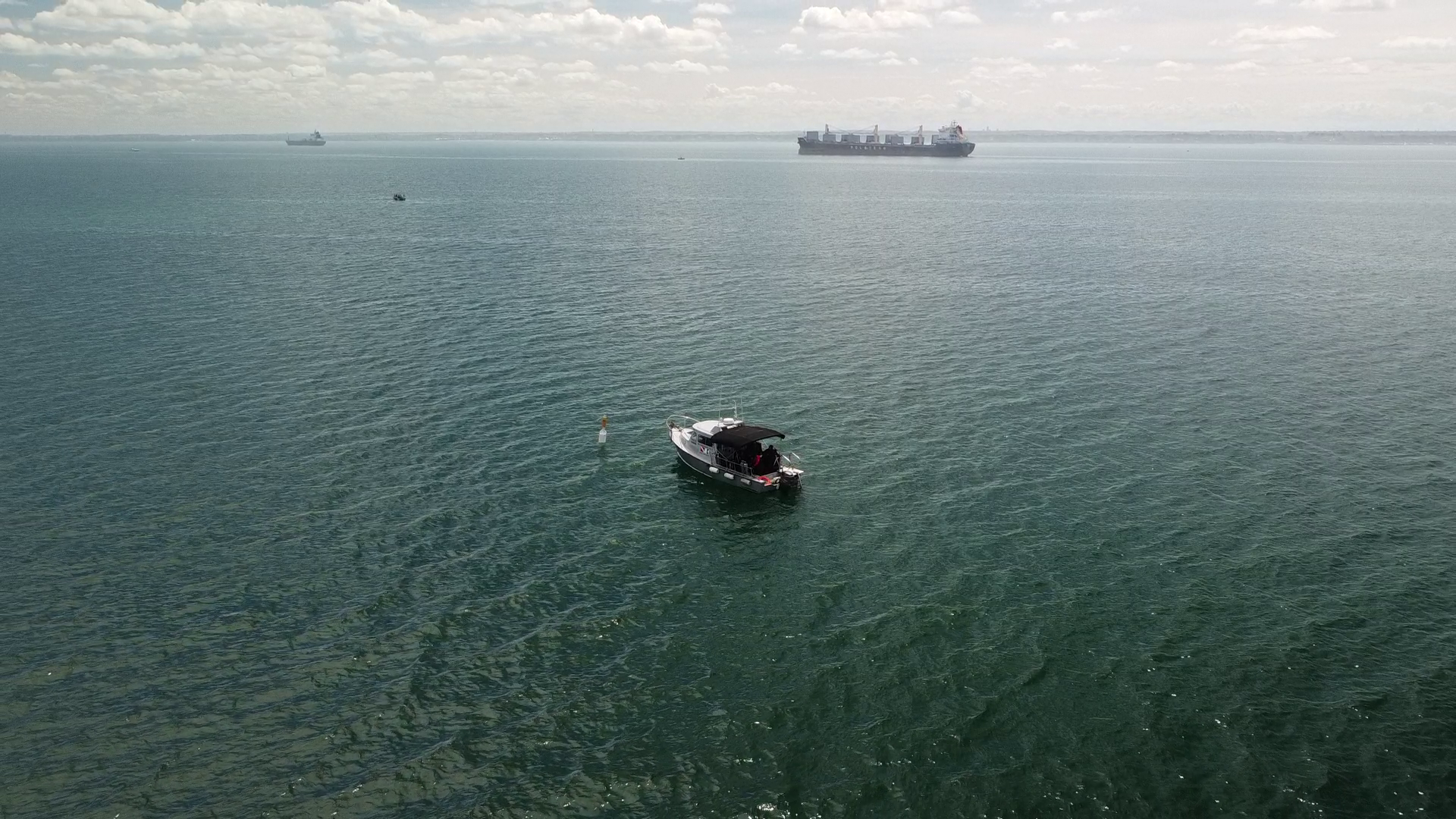
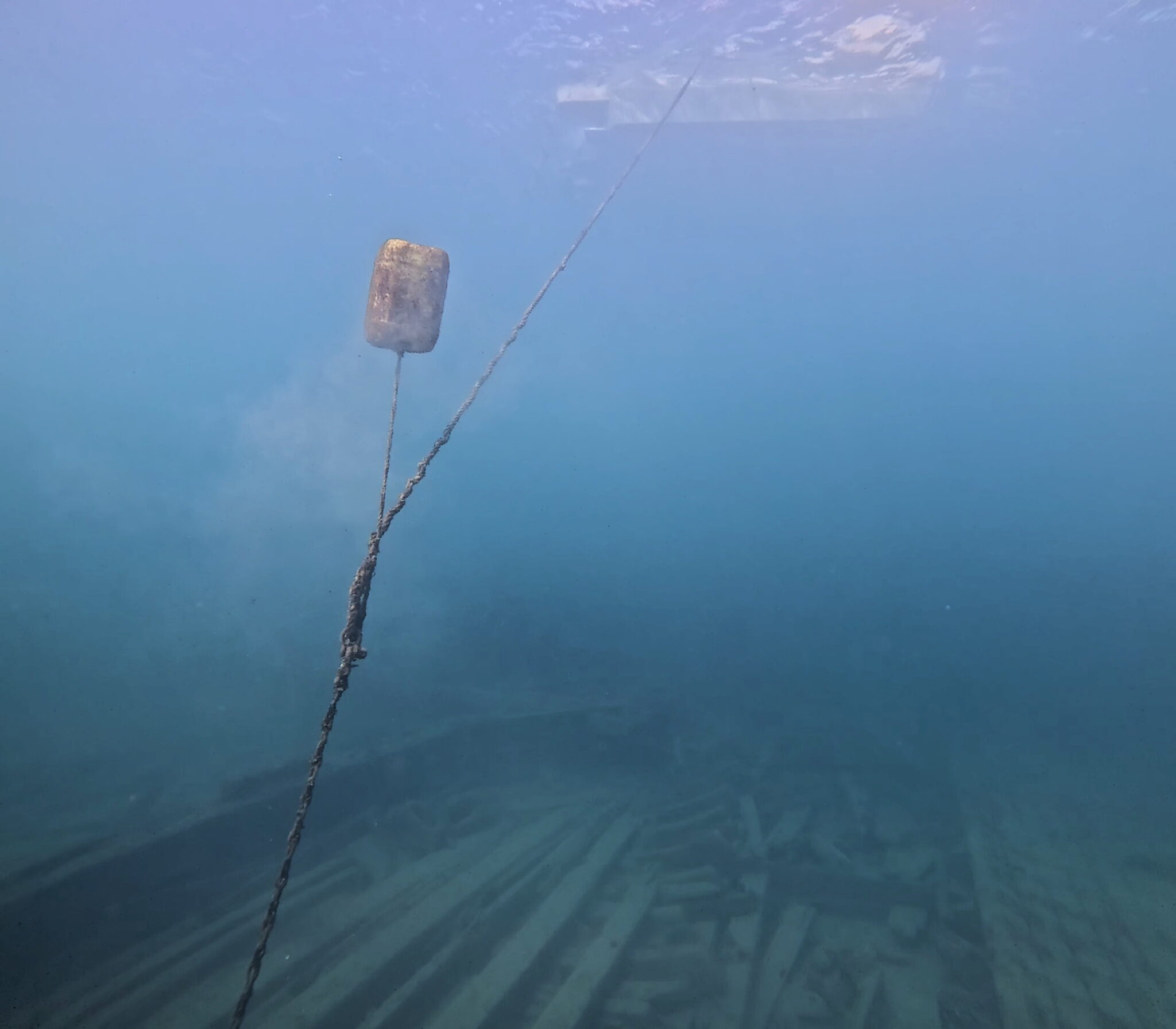
A mooring starts at the bottom, either attached to a large concrete block or a non-fragile portion of the wreck. Often, there is an underwater float that helps keep the line above the wreck to help avoid entanglement in bad weather or changes of wind direction. There is then the line that goes to the surface attached to a marker buoy, which is often registered with Nav-Can marine charts. These moorings are funded by donations and are deployed by volunteers to help not only mark these shipwrecks for surface vessels but also allow dive charters to have a secure connection to the wreck while they have divers in the water without having to drop an anchor or use a shot line. For divers, these mooring lines are an invaluable tool that divers use to help visually guide them to the wreck, but also use as a sturdy ascent line for safety stops, decompression stops or aid in emergency management.
Beyond Moorings: Tackling Ghost Nets and Other Threats
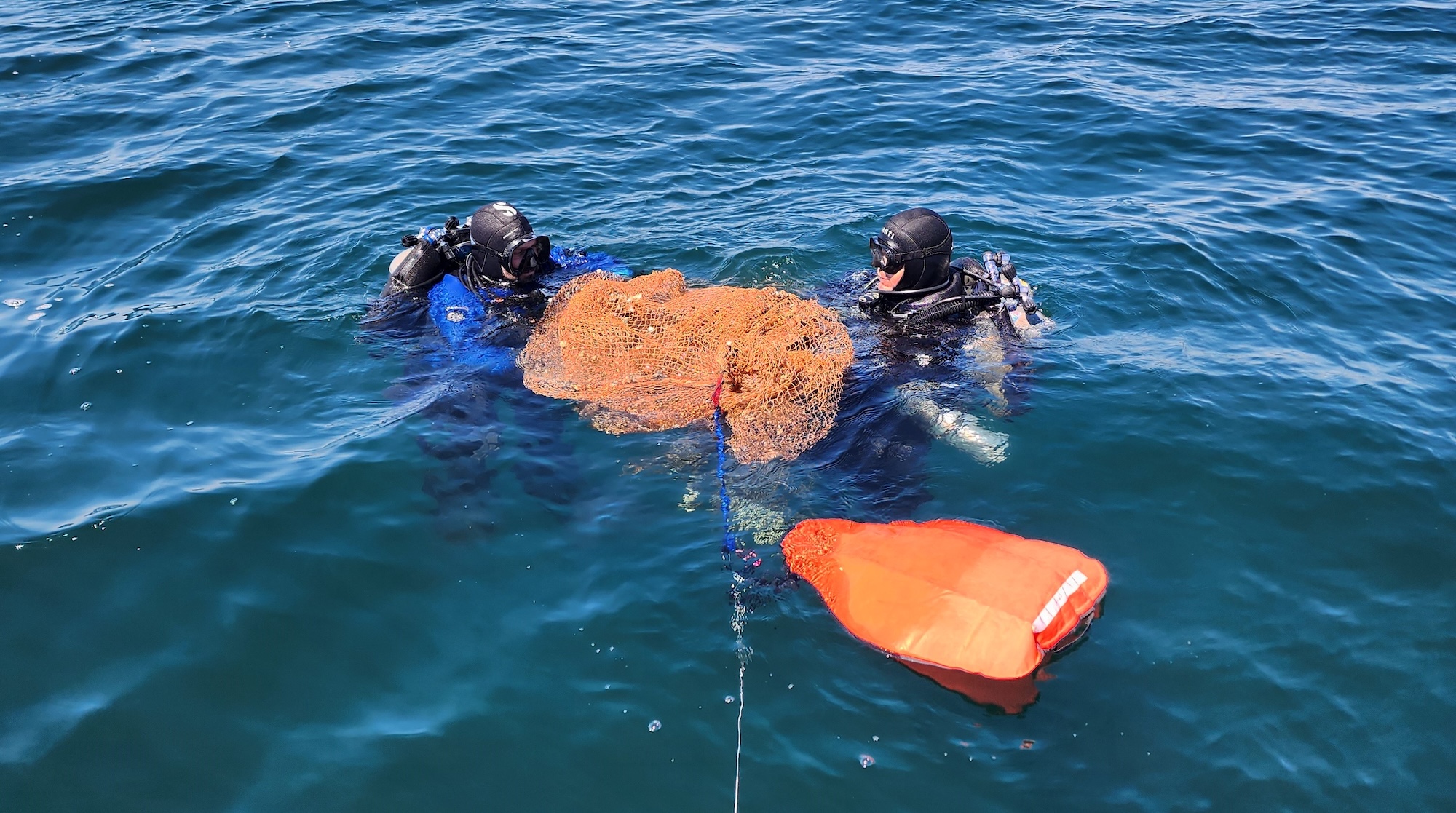
In addition to the moorings, shipwreck preservation sometimes requires additional tasks. Last year, we also needed to remove a large ghost net. A roughly 500lb (227kg) large fishing net adrift in Lake Erie draped itself over the stern of a shipwreck named the Niagara. This large 136-feet (41-meter) wooden shipwreck that sank in 1899 had the net intertwined with the loose timbers of the stern, putting stress on the remaining structure as well as creating a potential hazard for divers. After several dives with our volunteers and the use of cutting tools and lift bags, we were able to remove the net, helping prevent further damage to this historical shipwreck.
Organizations like SOS throughout the Great Lakes are made up of hundreds of members who are often volunteers dedicating their time and energy to help not only preserve these historic wrecks for future generations but also provide infrastructure for divers of all levels to explore the shipwrecks safely. Many chapters also host fundraisers or educational presentations for divers and non-divers looking to learn more about the maritime history of the Great Lakes. For me and countless others, these shipwrecks are more than dive sites; they are stories worth protecting, one mooring at a time.
Want To Dive in the Great Lakes?
The Great Lakes are home to some of the world’s most pristine and well-preserved shipwrecks — and they’re waiting to be explored. They’re also an ideal place to complete the PADI Dry Suit Diver Specialty and unlock greater access to historic wrecks and unforgettable underwater experiences. Ready to dive in? Click below to find a dive center.
About the Author
Chris Foisey is a PADI Scuba Instructor from St. Catharines, Ontario, Canada. A certified Cave Diver and Technical Decompression Diver, he has spent more than a decade teaching divers, maintaining scuba equipment and exploring underwater environments around the world. Chris works with Dan’s Dive Shop, Canada’s oldest PADI facility and is the creator of the Modern Diver Channel, where he shares tips, gear advice and stories to inspire today’s modern divers.
Follow him at @moderndiver (TikTok) or @moder_diver_channel (Instagram).