
In this firsthand account, Birgitta Mueck, one of our PADI AmbassaDivers, takes us on an unforgettable, cold-water adventure through the northern fjords of Sweden and Norway. Sailing more than 1,300 nautical miles (2,400 kilometers) aboard her expedition yacht, Birgitta explores remote dive sites, encounters rare, cold-water species and ventures into the Arctic in search of feeding orcas and humpback whales. Read on for her story…

The Journey Begins
Well above the Arctic Circle during the darkest months of winter, deep in the fjords of Norway, there is something spectacular happening. It is in the county of Troms, at around 69 degrees north, where hundreds of orcas and humpback whales have started to gather during the cold and dark winter months – an extraordinary wildlife phenomenon that started only six years ago and that will likely only last a limited time.
Northern Norway has always been a great spot for observing whales of various kinds all year round. But these enormous numbers of orcas and humpback whales that have started to appear annually in the fjords of Troms, peak between November and February. This is the time when great quantities of whales can be seen even far inside the fjords.
The reason for this is the huge schools of herring that come here. The whales follow the herring, their main food source, in Norway. This overwhelming wildlife event, where such big numbers of both feeding orcas and feeding humpback whales can be seen next to another, is very rare.
In an effort to document this unique scenario, we are sailing north towards the long Arctic winter with our expedition yacht, where we will attempt to film these impressive marine mammals from both above and beneath the surface.
Will we be in time to find the majestic marine mammals that we are looking for? And what results will we be able to get when facing the very dark and cold conditions that Northern Norway provides during its long winter?

Setting Sail From Sweden
Our adventure started on an island off the Swedish west coast in early September. The name of this flourishing island is Orust, which is also the place where I grew up, and where our expedition yacht has her home port. From here the voyage continues north.
Our journey covers more than 1,300 nautical miles (2,400 kilometers), across the strait of Skagerrak in Sweden to the southern tip of Norway, then north along its majestic coast, all while exploring some of the most impressive fjords of Scandinavia. We will be making different dive stops along this great Norwegian coast, before finally reaching the breathtaking fjords of Troms in Northern Norway.
The boat used for this expedition is our 45-foot (13.7-meter) sailing boat Eja af Slussen. During the last 15 years, we have sailed over 40,000 nautical miles (74,000 kilometers) with her, to both warm and cold latitudes.
So many miles have been completed with only one mission in mind: to document the various kinds of aquatic life we find in our oceans. Through our films, which are mainly in cooperation with Swedish National Television, we aim to spread awareness, raise interest and develop knowledge for the marine inhabitants, and to show how threatened they are by increasing human economic interest. This strong passion for the ocean has become a total lifestyle for me. When not at sea filming for our family-run company, Crystal Water Film Production, I work as a guide and PADI Divemaster at different locations around the world, from Antarctica in the south to the high Arctic in the north. Whether I am in warm, tropical waters, or in the much more demanding cold latitudes, my fascination for the amazing life hiding beneath the surface never stops growing.
Our current sailing trip, here in Norway, brings me to extraordinary dive places where I yet again have the chance to experience amazing underwater encounters. Keep reading and travel along to the long and dark Arctic winter and, like me, hopefully be amazed by the stunning life living in these cold waters!

Drop-Off Dives With Cold-Water Sharks
We make our first dive stop in the southwestern part of Norway. Our aim is to find the spiny dogfish (Squalus acanthias), a shark species that once was the most abundant in Scandinavian waters. However, due to overfishing, the population has decreased by at least 95% during the last three decades. Will we still be able to find them?
To try and find this shark, measuring up to 1.5 meters (5 feet) long, we will be diving along a 300-meter-deep (984-foot) wall. The murky water surrounding us has a temperature of 13°C (55°F). The deeper we go, the darker it gets. At 40 meters (131 feet), which is our maximum depth for this dive, we hardly see any light from above. The bright film lights shine on a huge variety of cold-water anemones in various sizes covering the entire of the steep wall. It is such an amazing sight to see this hidden, cold-water beauty. We all know about the colorful corals living in tropical seas, but not so many of us are aware of the great beauty found in the much colder and darker waters.
My attention suddenly shifts when a slow-moving shadow starts to appear on the wall. By watching the movements gradually coming closer, I soon understand that it is indeed the spiny dogfish we are looking for. This slender shark seems to be curious about our expedition and starts to circulate around us.
Sadly, this friendly little being is classified in the IUCN Red List of Threatened Species as critically endangered in the Northeast Atlantic. Sadly, this shark species is a late maturing fish. The females mature at an age of 18 to 21 years, giving birth to only a small number of living offspring (2 to 11) after a two-year gestation period. So, it is very hard for the population to recover. Like many other species of sharks, the spiny dogfish is considered particularly vulnerable to over-exploitation and is a species which would benefit from better and bigger protected marine areas.
As most of us know, all species great or small play a crucial role in the balance of life on Earth; none should be forgotten or be allowed to vanish from their natural ecosystem.

The Journey Continues
Our voyage continues to Trondheimsfjorden, which is a fjord in the west-central part of Norway where I have spent plenty of time before.
This is the fjord where the world’s shallowest cold-water coral reef, Lophelia pertusa, is located. Deep-water species of reef-building coral, which normally live at depths between 100 and 1,000 meters (328 and 3,281 feet) or more, can be seen in this shallow fjord.
In 2000, a local diving club “Leksviks dykkeklubb” found this extraordinary reef at a depth of approximately 40 meters (131 feet) inside Trondheimsfjorden. Since then, it has become the shallowest cold-water coral reef known in the world, and it is the main reason for my many dives at this particular spot.
This time, however, we are here to film something totally different. Our aim is to find and document a mythical creature with the Latin name of Chimaera monstrosa meaning ”Mythical Fairytale Creature”, which I find suits this extraordinary being very well. The ghost shark, also known as rabbit fish, rat fish or spook fish, is a deep-water creature normally living at depths of 100 meters (328 feet). But in some of the Norwegian fjords, such as here in Trondheimsfjorden, there are places where ghost sharks can be found in much shallower water when diving at night. Therefore, to be able to find them we will need to dive at night. We anchor at the spot where we hope to have a chance to find the mysterious creatures we are looking for.
Once the darkness has arrived, it is time for us to jump into the rather ”refreshing” water. As expected, the water temperature decreases as we go north, and my dive computer now shows 10°C (50°F). Surrounded by an enormous amount of glowing bioluminescent plankton, we start descending along our 30-meter-long (98-foot) anchor chain and soon turn on our underwater film lights to be ready to document any encounters. Some cod fishes and a small lobster are the first critters I see next to the small wreck resting on the sandy bottom.
At a slow pace, I cautiously swim into the infinite dark surrounding us, carefully looking all around me. It doesn’t take long before I see, further in the distance, two eyes reflecting the light. I stop and patiently wait for the creature to come closer. While hovering just above the sandy bottom, all my attention goes to the glowing eyes in the dark which are getting bigger and bigger the closer they get. There is no doubt about it, it is a ghost shark! With slow movements, it makes a couple of loops around me, before settling down on the bottom again, continuing to search for food among the seashells.

Like most sharks and rays, ghost sharks have cartilaginous skeletons. They can grow up to 1.5 meters (5 feet) long and mainly feed on bottom-living invertebrates. For defense, this cute little fellow has a venomous spine located in front of the dorsal fin. Being a very peaceful creature, there is no need to worry when diving with this friendly-looking fish, as long as you behave in a good and respectful manner.
The time underwater feels way too short when diving with these magnificent animals (as I haven’t found a way to start growing gills like a fish yet!), and it’s too quickly time to wave goodbye to my nocturnal, aquatic friends and start our ascent back to the boat. It is already the second week of October, and we have now only a couple of weeks left before the whales should start to appear in the fjords of Northern Norway. Time for us to head even further north and sail our remaining 500 nautical miles (900 kilometers), hopeful to soon meet the whales.
Crossing the Arctic Circle
It’s such a wonderful feeling when we finally reach the northern part of Norway after a couple of months on the move sailing our boat along the beautiful coast. We are now entering the Arctic Circle, and we don’t have many days left before finally reaching the mountainous county of Troms in Northern Norway. Both orcas and humpback whales have annually been flocking to the area in astounding numbers, but will the herring and the whales show up again also this year? Nature only knows, and only time will tell us.
We find a nice little fishing harbor on Vengsøy Island, where we decide to base ourselves for some time. This charming island is situated slightly west of Tromsø, and it is one of the spots where the whales normally appear during late October. My gut feeling tells me that this is the place to be to hopefully find some whales soon.
Every day that passes by gets shorter and colder. When the long, dark nights are clear, the sky often puts on a fabulous show ofg northern lights. The snowy mountain landscape surrounding us is simply breathtaking, and so is the everlasting sunrise and sunset that envelops everything in its stunning colors. No matter if it’s sunny or grey, the ever-changing scenario surrounding me never ceases to impress. Such amazing scenes both day and night, but where are the whales?

And So the Season Starts
We have now arrived in Vengsøy Island, and the local fishermen have told us that only a small number of herring have entered the fjords so far. They are all still waiting for the bigger schools of fish to appear, which also influences the migration route of the whales.
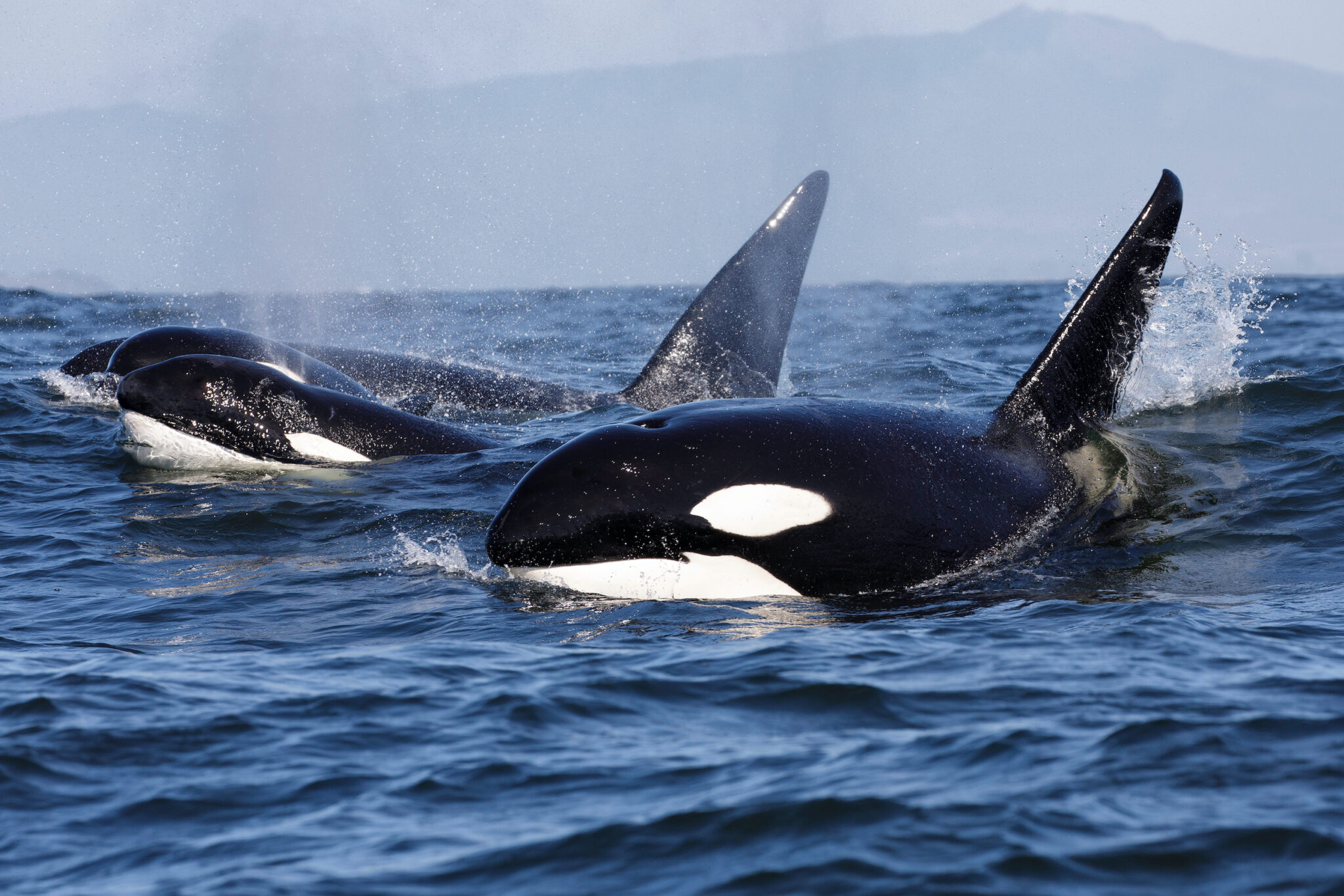
We head out from the fjords to have a look a bit further out to sea. The low sun reflecting on the mirror-like ocean surface gives the entire surrounding a warming touch, despite the cold air biting both my cheeks and nose. Suddenly, something starts to appear further in the distance. It looks like a blow closer to the horizon. Keen to get a closer look, we change course towards it. I feel the adrenaline rising through my entire body when I, through the binoculars, see the big black dorsal fins gracefully cutting through the surface. There are no doubts about it – they are orcas!
The biggest member of the dolphin family, orcas are toothed whales reaching a maximum length of 10 meters (33 feet). These highly social marine mammals live together in big, stable family groups. Sometimes called “the wolves of the sea,” but more commonly named “killer whales,” orcas have a wide range of reputations, from having the souls of humans to the most merciless killers. In earlier days nobody dared to enter the water if an orca was in sight. Today we know more about these majestic creatures. They are not merciless killers, but intelligent mammals specialized in different prey. Found in all oceans, orcas hunt a great variety of prey, such as fish, cephalopods, seals, sea lions, whales, sea birds and sea turtles. They are, however, food hunting specialists, which means that the orcas particular type of prey differs a lot between the different populations. Here in Norway, for example, orcas have specialized in herring, which is their main food source.
Our boat is now surrounded by hunting orcas, and the sky above us quickly starts filling up with many hungry seagulls and eagles, who also want their part of the herring feast. Ready in my drysuit, and with the underwater camera in my hands, I slowly slip into the 7°C (45°F) water (yes it got colder!), trying to create as little splash as possible. The loud noise from the screaming seabirds quickly gets replaced underneath the surface by the much more soothing and enchanting variations of sounds that the orcas create. The cold, salty water bites the naked skin on my face, but I quickly forget about it when I see a huge dark shadow in front of me. It is a big male orca curiously swimming towards the little snorkeler that I am.
Compared to his large body, his eye looks very small and filled with curiosity when looking at me before swimming back to his pod. I hear a repetitive cracking sound in the water, and understand it is the sound from the powerful tail-slaps the orcas make to numb their prey.

Tail-Slapping Orcas
The Norwegian orcas use a specific method to efficiently hunt and feed on herring. To trap the school of fish, they have developed a special technique called “carousel feeding,” a system of teamwork which is happening right in front of me. The orcas take advantage of the herring’s defense mechanism, which is to form a tight defensive group creating confusion in the predator’s mind.
To trigger the herring to group, the pod of orcas release bubbles and show the white underside of their bodies while circling the herring. This frightens the fish closer and closer together, creating what is called a bait ball. When the herring are sufficiently grouped, the whales swim closer and slap the edge of the ball with their tails (tail-slapping), which can numb or kill up to 10 to 15 herring with each successful slap. The orcas then gently start to eat the stunned herring one by one. As sometimes happens, the carousel feeding migrates towards me, but the orcas don’t seem to be bothered about my presence in the water.
As I want to have as little influence as possible on their world, I always minimize all movement forwards or backwards. So even when the bait ball comes in my direction, I try to stay as discreet as possible just beneath the surface while filming the spectacular wildlife phenomenon happening in front of my eyes.
Once again, I’m totally overwhelmed. I no longer think about the breathtaking mountain peaks, nor the magic of the northern lights. Here and now it’s only me and the orcas enjoying their lunch in their cold, but yet so amazing, Arctic paradise.
What a great beginning of our stay here above the Arctic Circle. Who knows what other experiences this Arctic adventure will bring as this is just the start of a long season with the winter whales.
Inspired To Start Your Own Adventure?
From exploring cold-water dive sites to encountering incredible marine life, scuba diving opens up a world of underwater adventure.
Start planning your next dive trip with PADI Travel.