You’ve decided to take the plunge, quite literally, found a great place to learn to scuba dive, and signed up for your PADI Open Water Diver course. Congratulations! We’re excited to welcome you to the PADI family and the beautiful underwater world you’re about to discover.
You’ll start by learning the principles of scuba diving, either through PADI eLearning or in person. Then, it’s time to get your feet wet during confined water or pool sessions before making your first open water dive.
Most people understand what an open water dive involves. But many new divers aren’t sure what happens during confined water or pool sessions and why they’re necessary. Read on to learn why they’re such an important part of the journey to becoming a certified scuba diver.
Why Do I Need To Do Pool Sessions First?
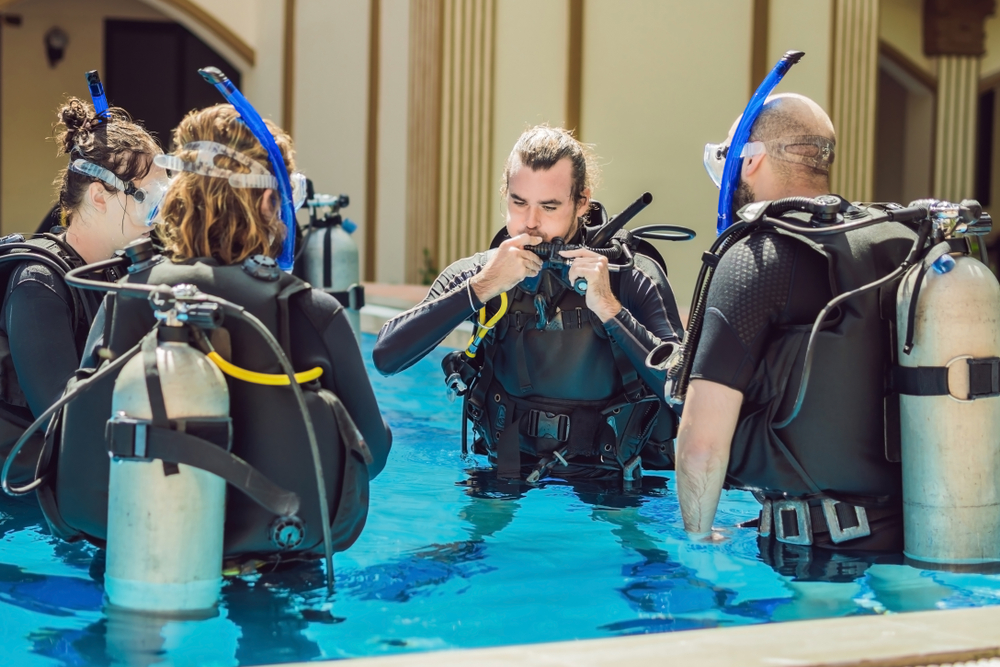
Before you can run, you must learn to walk. In scuba diving, that first step happens in confined water. They provide a calm, controlled environment where you can take your first breaths underwater and practise essential skills before heading into open water.
While open water is the ultimate goal, it can feel intimidating at first. During your Open Water Diver course, you’ll learn many new skills. Adding the ocean or large lakes into the mix too early can make situations unnecessarily complicated.
That’s why the course begins in confined water, where you can learn and practice essential scuba skills in a controlled environment. The calm conditions make it easier to build confidence and master each step before moving into open water.
What Is Confined Water?
What does “confined” or “confined water dives” actually mean? In scuba speak, it refers to a swimming pool or an open water site with pool-like conditions. This means clear, calm water with both shallow and deeper areas where you can practice course skills.
Many PADI Dive Centers use an actual swimming pool, so for simplicity, we’ll refer to these sessions as pool sessions going forward in this article.

Which Skills Will I Learn During the Pool Sessions?
During your PADI Open Water Diver course, you won’t be thrown into the deep end. The course is designed to develop your skills step by step, starting with pool sessions.
In these confined water or pool dives, you’ll begin your initial skills training. Your instructor will evaluate your skills to ensure you’ve mastered them before moving on to demonstrate them in open water.
Each dive has specific performance requirements and prerequisites that determine the order in which skills are introduced.
The skills you’ll learn include, but are not limited to:
- Breathing compressed air from a regulator, recovering and clearing it
- Inflating and deflating a BCD, hovering and practicing neutral buoyancy
- Descending and ascending using the proper technique
- Clearing, removing and replacing a mask as well as breathing without one
- Emergency procedures, such as breathing from an alternate air source and a tired diver tow
- Basic dive planning.
- Using appropriate hand signals
Scuba Equipment for Pool Sessions
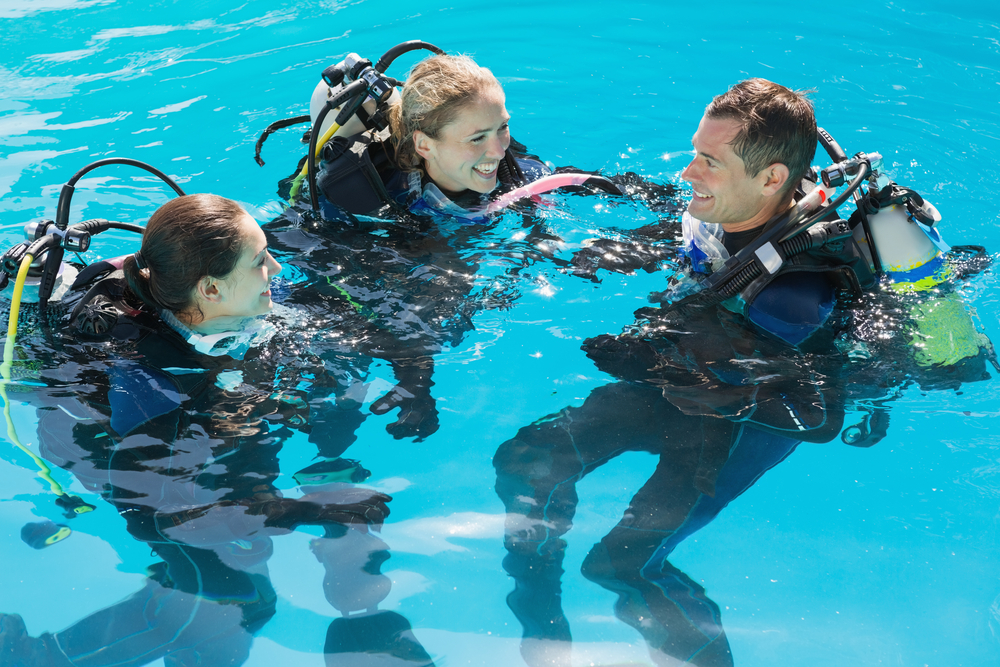
Another important part of pool sessions is getting familiar with your equipment. You’ll learn to assemble and put on your scuba kit at the surface. This includes your mask, fins, snorkel, BCD, scuba cylinder (tank) and weight system. You’ll also make any necessary adjustments to ensure a proper fit. At first, your PADI Instructor will assist you, and later you’ll practice putting on your kit with the help of a buddy.
Once everything is in place, you’ll conduct a pre-dive safety check with your instructor or buddy. After the dive, you’ll learn how to disassemble your scuba kit.
In the confined water dives that follow, you’ll also practice removing, replacing, adjusting and securing your scuba kit and weight system both at the surface and underwater.
Many new divers wonder if they need a fixed buddy for the course, and the answer is no. During the Open Water Diver course, you’ll be paired with other students for buddy checks and skills, and these pairings can change from dive to dive. You’ll learn the important rule that scuba divers should never dive alone, but you’ll also see that you can safely dive with any certified buddy.

What Do I Need To Bring for My Pool Sessions?
Before you jump in, make sure your forms are in order. Your PADI Instructor will tell you exactly what’s required. This usually includes:
- Release of Liability/Assumption of Risk Agreement/Non-agency Acknowledgment form / EU – Statement of Risk and Liability/Non-agency Acknowledgment form
- Diver Medical Form
- Standard Safe Diving Practices Statement of Understanding
If you’re transferring from another PADI Dive Center (or another training organization), you’ll also need your Open Water Diver Course Record and Referral Form.
During your pool sessions, you’ll also learn to plan a dive using the PADI Skill Practice and Planning Slate. Your instructor will provide one, or you may choose to have your own for future dives.
Depending on which confined water dive you’re doing, you may need to complete a Knowledge Development session beforehand. Your instructor will inform you if this is the case.
In addition, remember to pack the following things for your pool session:
- Swimming costume and/or rashguard with shorts or leggings
- Towel
- Change of clothes
- Sun protection if the pool is outside
- Water and/or electrolyte drinks
- Snacks for after the dives
Your instructor will tell you in advance if you need to bring your own equipment and/or an exposure suit. Most commonly, it’s possible to rent equipment. But, some instructors require you to have your own mask, snorkel, fins and exposure suit.
Most importantly, get excited — your first pool session is the first step into a whole new world!
Ready To Get Scuba Certified?
The underwater world is waiting, and there’s no better time to start your journey to becoming a certified PADI Open Water Diver. Begin today with PADI eLearning and take your first step toward a lifetime of adventures below the surface.