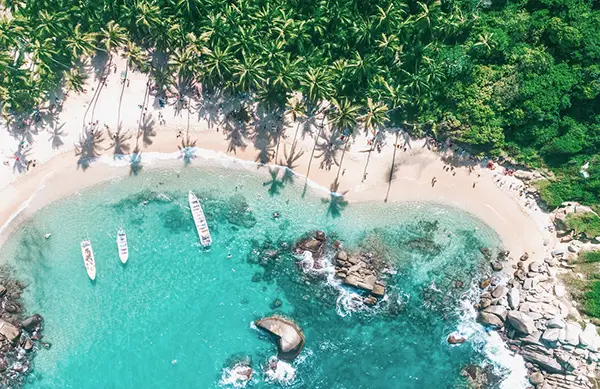
In December last year, I celebrated my 34th birthday by doing something I had dreamed about for years: scuba diving. I completed my first dive at Havelock Island (also called Swaraj Dweep) in the Andamans on the day, and earned my PADI Open Water Diver certification the next day.
As someone who came of age as a closeted young boy in India during the late 1990s and early 2000s, I spent decades struggling to find my voice in a society. Now, at 34, I am more comfortable with my identity. However, the journey of self-discovery was long and challenging, and it is one that has, in quiet but indelible ways, both shaped and reshaped how I think of myself and my place in the world.
There is an incident from 2012 that I will never forget. After the brutal gang rape and murder of a young woman in Delhi — known across the world as the “Nirbhaya rape case” — I attended my first candlelight protest as a college student. That evening, I saw for the first time how important collective action could be in shaping conversations around change. Attending that vigil also encouraged me to reflect on questions I had never thought about before — like how identity shapes our experiences and opportunities in the world
Over the years, these curiosities grew into a deeper calling, and today, I teach a course on queer rights and politics to undergraduate and postgraduate students at a law school in Bengaluru while simultaneously working with academic, media and nonprofit groups in India’s legal aid space.
But what does any of this have to do with scuba diving?
And how can diving — of all things — be a queer experience?
Let me explain.
Sinking Into myself
The last few years of my life had been a period of intense upheaval. I spent the time recovering from a painful breakup with my same-sex partner, navigating a major career transition across cities and trying (with great difficulty) to heal from an unexpected medical condition that landed me in the hospital — all at the same time. Thankfully, I’m doing well now, but each of those experiences made me realize something important about my health.
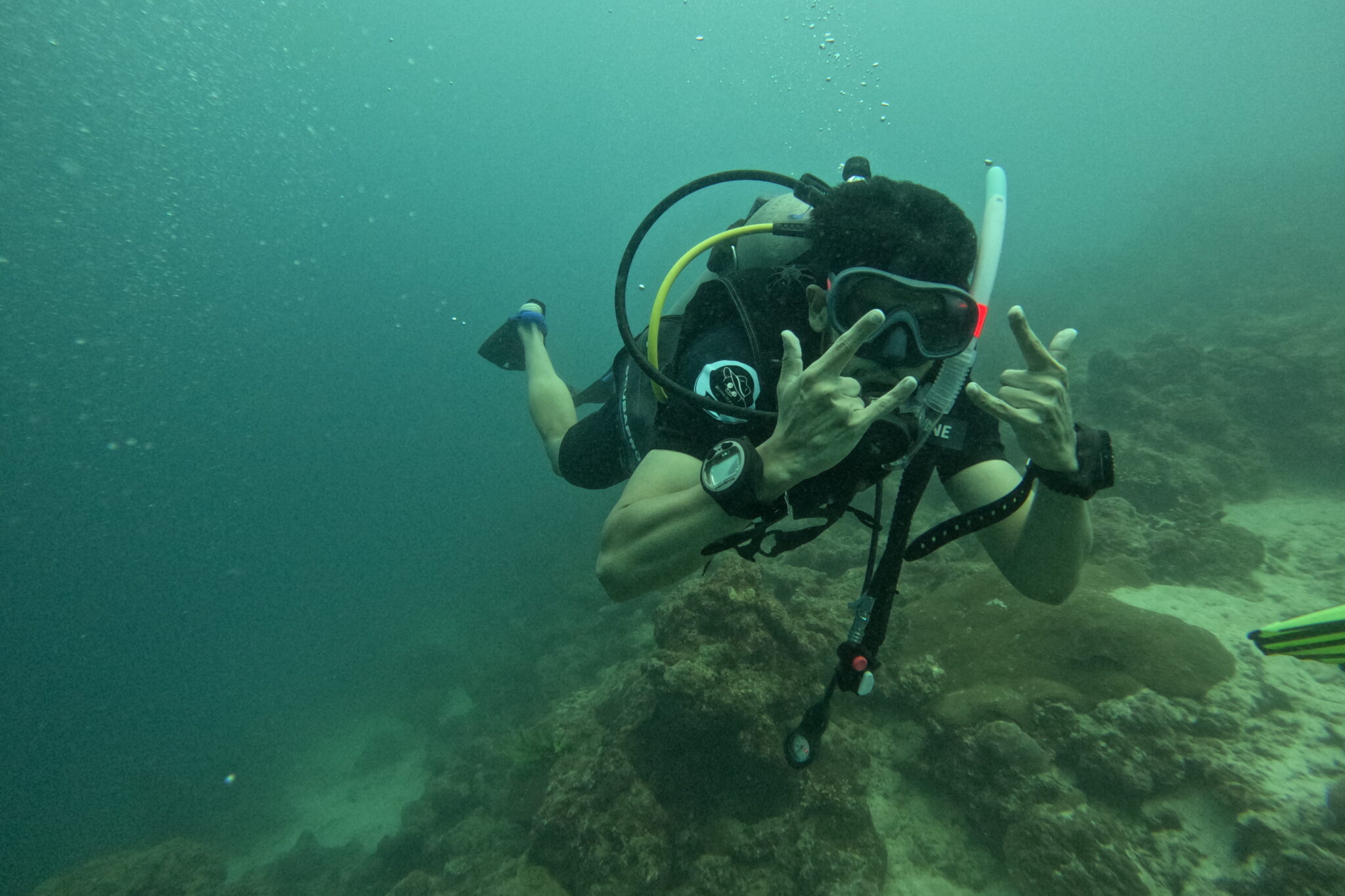
A few weeks before my 34th birthday, I decided to enroll in PADI’s Open Water Diver program in order to challenge myself and reclaim a sense of freedom I hadn’t felt in years. Even though I was nervous at first, I went ahead with it. After completing the theory section of the course, I finally felt ready. I was ready to take the plunge — literally — into the ocean. And weeks later, I was there, by the oceanside, ready to go down.
I distinctly remember my first descent.
The moment my head slipped beneath the surface, the world above me immediately dissolved into an otherworldly tinge of blue. Time and space collapsed, and I lost any sense of what a minute or an hour even was. My sense of distance began to crumble, with faraway objects appearing closer than they were and nearby ones seeming farther away. Sound started behaving strangely, and colors gradually started fading with depth. As the light from above filtered through the water, I began seeing the corals all around me shimmer in soft, iridescent hues. At one point, as my feet brushed against the sand, clouds of tiny particles slowly started rising around me. Everything — including myself — was suspended in the water as though gravity did not exist. I felt weightless, soundless and……breathless — all at the same time!
I also remember the ocean being eerily quiet. And yet, beneath that silence, I saw movement that I can only describe as some kind of “delicate resilience.” These were patterns of rhythm that were both gentle and unyielding. For instance, I saw clownfish wiggling shyly inside their anemones; colorful starfish stretching themselves across the ocean floor as though they were sunbathing on the beach; and schools of fish gliding with the precision of migrating birds. Each creature seemed to carry a sense of serenity that was calm yet steadfast, quick yet deliberate, and energetic yet controlled. It was as if the ocean were performing a concert, and I was its lucky witness.
Little by little, I felt myself soften underwater. The tension in my body — the rapid, jerky fluttering of my legs and the heavy huffing and puffing when I had just entered the water — slowly turned into deep breaths. As I surrendered to my own buoyancy, I felt more relaxed than ever before. Close to the completion of my dive, I remember feeling truly “there.”
“I wish I could live here,” I remember telling myself as I began my slow ascent.
Finding Meaning Beneath the Surface
Nirbhaya was assaulted on the streets of Delhi because of her sex. Queer and transgender people face violence and marginalization in India because of their sexual orientation and gender identity. Queer communities around the world continue to remain deeply vulnerable to laws and institutions that seek to restrict their existence. And yet, they persevere with courage, adapt with ingenuity and resist with strength, all the while building networks of kinship, friendship and solidarity as they “swim together” through murky waters. In many ways, the queer community has much to learn from its marine counterparts.
The ocean is also fluid. It is constantly shifting in form and temperament, and it is, in turn, influenced by currents far beyond its control. It offers safety to those who learn how to navigate it. In that sense, the ocean mirrors the outside world. It is a vast, shimmering expanse of beauty, depth and possibility all at once. In her essay, Queer Reefs, researcher and diver Rasa Weber describes the ocean as a ‘queer space‘ — one that is inherently conflicted, altered and degraded. But rather than seeking some kind of ‘lost purity,’ Weber argues we must embrace its ‘brokenness’ and imperfections – a fitting metaphor for the resilience and fluidity that queer communities embody every so often.
Scientifically, too, marine life is diverse in ways that challenge the rigid categories of gender and sexuality that most humans mistakenly regard as “natural.” As American ecologist Joan Roughgarden notes in the introductory chapter of her groundbreaking 2004 book, Evolution’s Rainbow:
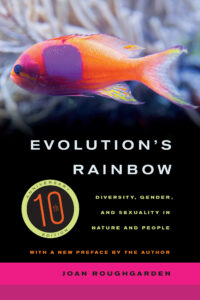
“I’m an ecologist — diversity is my job — and yet I was still astonished… how animal families live, how animal societies are organized, how animals change sex, how animals have more than two genders, how species incorporate same-sex courtship, including sexual contact, as regular parts of their social systems. This diversity reveals the evolutionary stability and biological importance of expressions of gender and sexuality that go far beyond the traditional male/female or Mars/Venus binary.”
In fact, Roughgarden chose the male squarespot anthias (Pseudanthias pleurotaenia) as her book cover. These fish begin life as females and can transform into males, depending on the social context. Their appearance dramatically shifts across sexes, and their bodies shimmer in vivid purples, pinks and oranges, forming literal, living rainbows.
A Closing Message
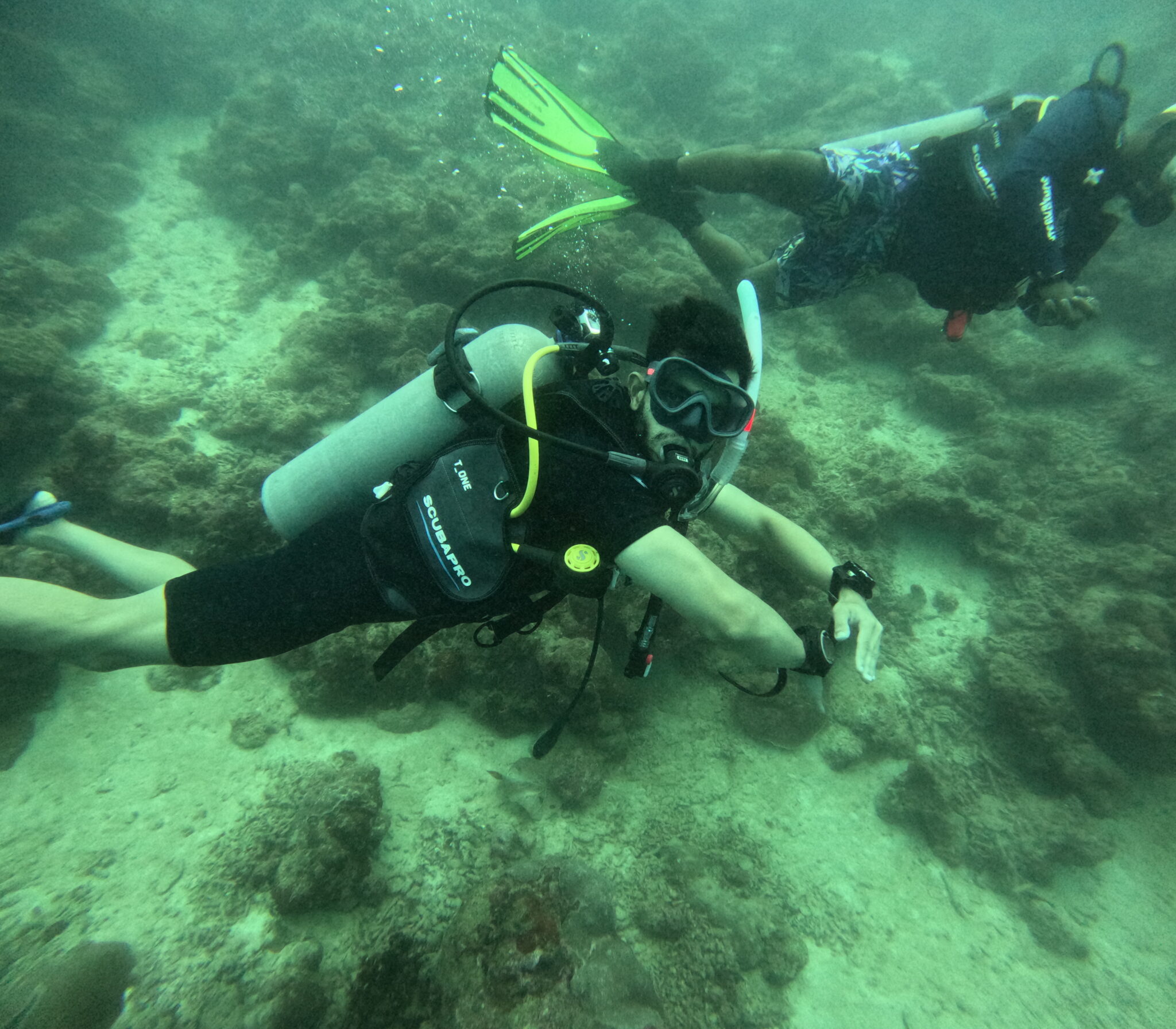
As I close this reflection on scuba diving, I hope more people consider taking the plunge to get certified as a PADI Open Water Diver. The theory component of the course teaches you about the science of the ocean and the physiology of the human body, but the actual practice teaches you how to cultivate humility, nurture patience, experience wonder and build trust with one another and the ocean ecosystem. Responsible diving also aligns closely with the UN Sustainable Development Goal 14: Life Below Water. When we bear witness to marine life up close, we gain a deeper understanding of why conservation matters in a way that is grounded in personal engagement rather than abstract theory.
Equally importantly, the ocean teaches us to slow down and recognize that time, space and identity are not always fixed realities. From the pull of gravity to the pressures of culture, each of these forces dictates the boundaries of our lives and the limits placed upon our bodies. To that end, the ocean is deeply humbling; or as Rachel Carson notes in the very first line of the preface to the revised edition of The Sea Around Us: “The sea has always challenged the minds and imagination of men, and even today it remains the last great frontier of Earth.”
This is precisely why, as divers, we must start thinking very seriously about the possibilities of ocean conservation as both a site of personal responsibility and a shared duty — not just a distant, abstract goal meant only for those working in the niche field of ocean conservation.
To that end, I am grateful that my first dive experience was this eye-opening. And now, I cannot wait to return to the ocean as an Advanced Open Water Diver.
Author Bio: Kanav Sahgal is a Program and Communications Manager at Nyaaya, a legal aid initiative of the Vidhi Centre for Legal Policy. He is a PADI-certified Open Water and Enriched Air (Nitrox) Diver and resides in Kolkata, India. All views are personal and do not necessarily reflect those of his employer.