Surrounded by ocean, Japan is home to countless unique dive destinations — many of which are just a short trip from major cities. One such treasure lies to the south of Tokyo and is called the Izu Islands.
Part of Tokyo Prefecture yet full of tropical island charm, the Izu Islands are strung along the path of the warm Kuroshio Current. This rich ocean flow creates an underwater paradise teeming with life, from schools of pelagic fish like amberjack and yellowtail, to vibrant tropical reef species.
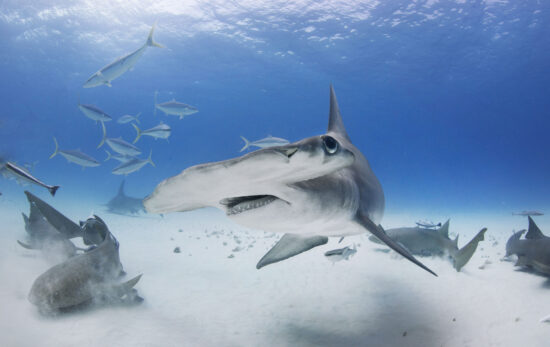
Sea turtles are a common sight, and if you’re lucky, you might even encounter thresher sharks, hammerheads, manta rays or even whale sharks, dolphins and whales. These islands hold the promise of unforgettable encounters, no matter your experience level.
Geologically, the Izu Islands sit on the eastern edge of the Philippine Sea Plate and were formed by volcanic activity. The result? Dramatic underwater landscapes shaped by lava flows and caldera rims, perfect for divers who love bold topography as much as marine life.
Keep reading for more information on the diving highlights of the Izu Islands.
Izu Oshima Island
Izu Oshima is the most accessible of the Izu Islands. By taking a jet ferry from Atami, you can reach the island in just 45 minutes — making its easy access one of its main attractions. The waters around the island are warmed by the Kuroshio Current, offering consistently high water temperatures, good visibility and a rich variety of marine life. As a volcanic island, the underwater terrain is filled with arches and crevices, and these dramatic formations are beautifully decorated with colorful soft corals. This creates a highly diverse underwater landscape for divers to enjoy.
From autumn through winter, the island becomes a hotspot for tropical fish. The island also features many beach-entry dive sites ideal for fish watching and underwater photography, such as the popular Akinohama. Even during strong winds or typhoons, diving is often possible by choosing a sheltered side of the island, which also makes Izu Oshima a popular training location for scuba courses.
Featured Dive Spot in Oshima: Akinohama
Akinohama offers everything a diver could ask for — boulder fields, sandy bottoms, slopes, walls and deep areas. Despite being a shore dive, many divers say it rivals, or even surpasses, boat-access sites in terms of quality and diversity. The dive site itself is expansive, with multiple routes available, making it a place you can dive again and again without ever getting bored.
The site is rich in marine life, from macro subjects to large pelagic species and even rare creatures from time to time. It’s especially popular among underwater photographers. Some divers say, “When I come to Izu Oshima, I only dive Akinohama.” A ladder is installed at the entry point, making both entry and exit easy — a nice bonus for divers of all levels.
How To Get There
From Tokyo’s Takeshiba Pier, a large passenger ferry operated by Tokai Kisen departs once daily and takes about six hours. High-speed jet ferries are also available from Takeshiba, cutting the travel time to around one hour and 45 minutes. Additionally, you can reach Izu Oshima from Atami in about 45 minutes. On weekends and holidays, there is also access from Kurihama.


Hachijojima Island
Located about 287 kilometers (178 miles) south of Tokyo, Hachijojima Island is the second-largest of the Izu Islands, with a coastline stretching approximately 51 kilometers (32 miles). Bright tropical flowers, like hibiscus and bird of paradise, bloom across the island, creating a lush and colorful southern-island atmosphere.
The island’s two iconic volcanoes, Mount Hachijo-Fuji and Mount Mihara, formed the land through overlapping lava flows, giving the island its dynamic topography both above and below the surface.
Underwater, Hachijojima Island is best known for its extraordinary biodiversity. More than 700 species of fish can be found here, including endemic species, like wrought iron butterflyfish and Japanese swallow, plus marine life from both the Izu Peninsula and southern Okinawa. From tiny frogfish and nudibranchs to schools of amberjack and dogtooth tuna, and even occasional sightings of thresher sharks and hammerheads, the island promises unforgettable dives for all experience levels.
Featured Dive Spot in Hachijojima Island: Nazumado
Nazumado is the most famous shore diving site on Hachijojima Island. With excellent tidal flow, it can sometimes present strong currents, but this also means exceptional fish density.
Here, you may spot large pelagics, like dogtooth tuna, amberjack, rainbow runners, yellowtail and skipjack tuna. Sharks, such as hammerheads and threshers, also make appearances. The reef is home to local specialties, like wrought iron butterflyfish, Japanese swallow, Purplemask angelfish and striped boarfish, along with small critters, such as harlequin shrimp and nudibranchs. It’s a well-rounded site offering something for every diver.
How To Get There
A large passenger ferry operated by Tokai Kisen departs daily from Takeshiba Pier in Tokyo, leaving at 10:30 PM. This convenient schedule allows even Tokyo-area residents to return home after work and still make the ferry in time. Alternatively, Hachijojima Island can be reached by air via Haneda Airport, with several flights available daily.


Kozushima Island
The name “Kozushima Island” is said to originate from the legend of Kamitsudoshima, meaning “Island where the gods gather.” According to myth, deities once assembled here to decide how to shape the Izu Islands. Located near the center of the Izu Island chain, Kozushima Island is strongly influenced by the warm Kuroshio Current, creating exciting and dynamic diving conditions.
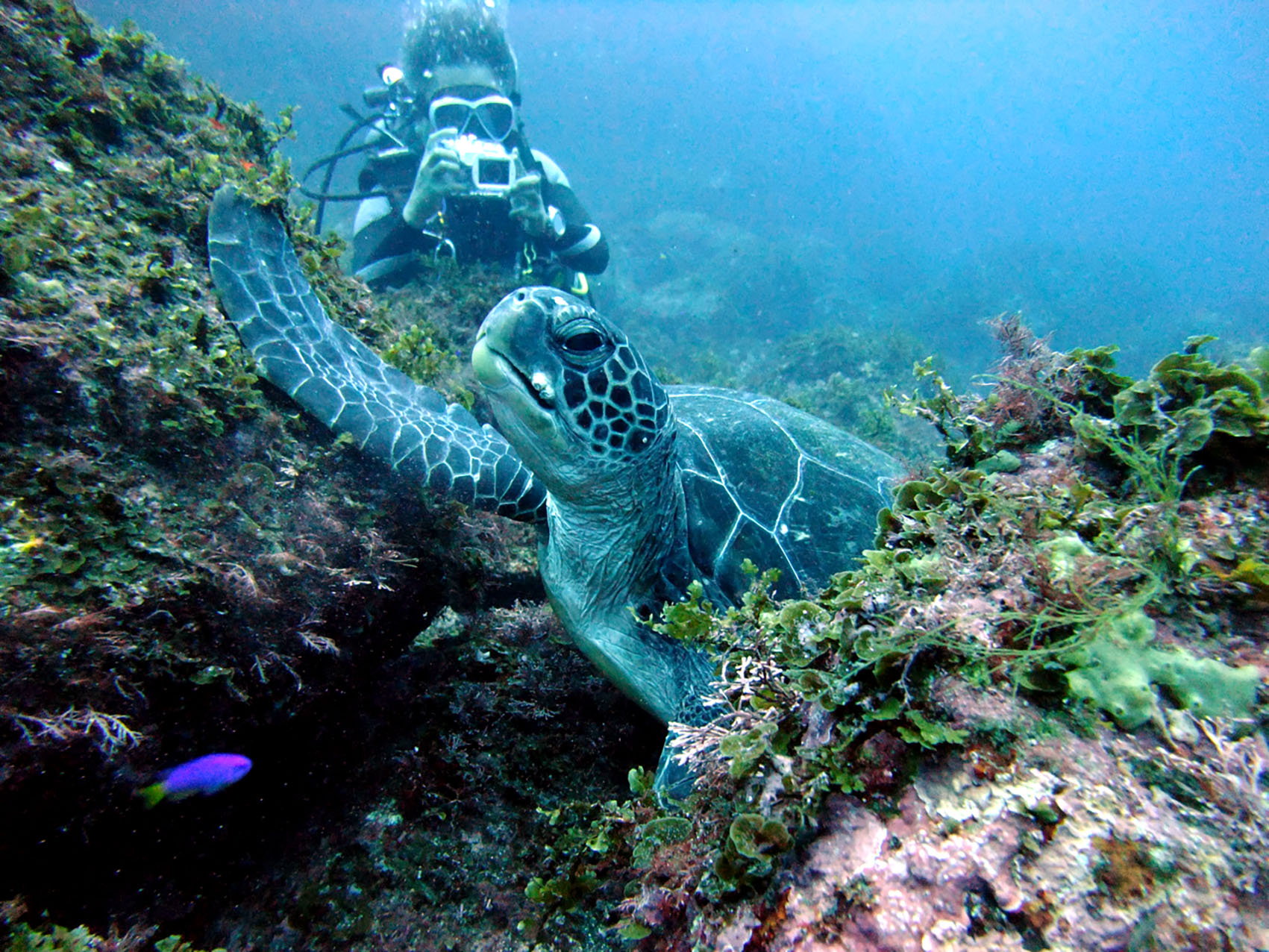
Famous as a rich fishing ground, the waters around the island are teeming with life. Divers can expect encounters with sea turtles, amberjack, rainbow runners and even schools of striped boarfish. On the calmer western side of the island, white-sand seabeds create a more relaxed setting, ideal for beginners, while advanced divers can enjoy the action-packed currents and reefscapes on other sides of the island. In addition to diving, Kozushima Island is also popular for surfing and other marine activities.
Featured Dive Spot in Kozuahim Island: Nagahama Sakune
Nagahama Sakune is a boat-access dive site known for its incredibly dense fish populations. Several rocky pinnacles dot the area, drawing large schools of damselfish, grunt and yellowstriped butterfish. You may also see groups of striped boarfish and redlip morwong, or even large predators, like longtooth grouper, cruising by. The site also features mini arches and unique underwater terrain. Due to frequent strong currents, this site is best suited for intermediate to advanced divers.
How To Get There
A large passenger ferry operated by Tokai Kisen departs once daily from Takeshiba Pier in Tokyo with a travel time of approximately 12 hours. High-speed jet ferries are also available from both Takeshiba Pier and Atami, taking about three hours 45 minutes and two hours, respectively. Additionally, seasonal ferry services are available from Shimoda.


Miyakejima Island
Located about 180 kilometers (112 miles) south of Tokyo, Miyakejima Island sits near the center of the Izu Island chain. After the eruption of Mount Oyama in 2000, the island was closed to visitors for several years, but tourism officially resumed in May 2005. Since then, travelers have returned to experience its unique landscape and vibrant marine life.
Lava from the eruption extended all the way into the ocean, forming dramatic underwater features, such as arches and drop-offs. At the same time, large colonies of table corals and colorful tropical fish offer a more tranquil, southern-island diving scene.
Dive sites are scattered around the island and include both shore and boat diving options, with a wide variety of environments that cater to divers of all levels, from beginners to pros. One of the island’s most popular attractions is dolphin swimming, where visitors can take a boat to neighboring Mikurajima Island for an unforgettable encounter with wild dolphins.
Featured Dive Spot in Miyakejima: Okubohama
Okubohama is Miyakejima Island’s signature beach-entry dive site, suitable for all skill levels. After entering from a black sand beach, divers encounter a variety of underwater environments, including boulder fields, sandy flats and rocky terrain. A wide range of marine life can be found here, from macro favorites like clownfish, seahorses and frogfish to schools of large pelagic species.
The site is especially popular among fish watchers and underwater photographers, as rare species often make surprise appearances.
How To Get There
A large overnight ferry operated by Tokai Kisen departs daily from Takeshiba Pier in Tokyo, leaving at 10:30 PM. This convenient schedule allows residents in the Tokyo area to go home after work before heading to the pier. Alternatively, Miyakejima Island can also be reached by plane from Chofu Airport, with flights operated several times a day.

Shikinejima Island
Located southwest of Niijima, Shikinejima Island is a small island with a circumference of about 12 kilometers (7.5 miles). Surrounded by a deeply indented coastline, the island is well-protected from wind, offering calm conditions ideal for diving.
The island features gentle beach dive sites, perfect for beginners, training and try dives. Meanwhile, boat-access sites offer encounters with schools of pelagic fish and vibrant soft coral gardens. One of the island’s most unique underwater experiences is a submarine hot spring, where bubbles rise mystically from the ocean floor and sometimes sea turtles can be found resting in the warm sand.
On land, the island is rich in natural beauty, including volcanic terrain and a giant tree said to be over 900 years old. Don’t miss the chance to soak in Shikinejima’s natural seaside hot springs, such as Ashitsuki Onsen and Jinata Onsen, which are accessible by foot and free of charge.
Featured Dive Spot in Shikinejima: Okama Bay (Underwater Hot Spring)
Okama Bay is a rare and globally unique dive site where hot springs bubble up from beneath the white-sand seafloor. Suitable even for beginners, this boat-access site is part of a CO₂ seep area — an environment where scientists study the potential impacts of future ocean acidification.
If you dig your hand into the sand, you’ll find it surprisingly hot. The site is home to guitarfish and large rays, and it offers a high chance of spotting sea turtles. Thanks to its rare geological features and ongoing research efforts, Okama Bay draws attention from marine biologists around the world.
How To Get There
A large passenger ferry operated by Tokai Kisen departs once daily from Takeshiba Pier in Tokyo with a travel time of approximately 10 hours. High-speed jet ferries are also available from the same pier, taking around 3 hours. Alternatively, you can take a ferry from Shimoda or fly from Chofu Airport to Niijima Island, then transfer to a local boat to reach Shikinejima Island.

Toshima Island
Located about 25 kilometers (16 miles) south of Izu Oshima Island, Toshima Island is a small, conical island formed by a stratovolcano. With its steep, mountainous terrain and untouched natural environment, it draws visitors not only for diving but also for hiking and stargazing.
Toshima is also known as “The Island of Camellias.” Around 200,000 wild camellia trees (Yabutsubaki) grow across the island, and camellia oil production is a thriving local industry. The island’s camellia oil is especially prized for its high quality.
Beneath the waves, the island is strongly influenced by the Kuroshio Current, which brings nutrient-rich water and attracts a wide range of marine life, from green sea turtles and sharks to large pelagic fish. Pods of wild Indo-Pacific bottlenose dolphins are known to frequent the waters around the island, making dolphin swimming another popular activity.
Featured Dive Spot in Toshima: Kemeishi
Kameishi is a dynamic boat diving site recommended for intermediate to advanced divers. It’s typically enjoyed as a drift dive, and, as its name suggests, it offers a very high chance of encountering sea turtles. On a single dive, you may spot up to 10 turtles cruising through the crystal-clear waters.
The site also sees regular appearances by large schools of pelagic fish, such as amberjack, yellowtail and striped jack. On rare occasions, even hammerhead sharks may pass through. With towering walls of fish and excellent visibility, this site delivers truly breathtaking underwater scenes.
How To Get There
A large passenger ferry operated by Tokai Kisen departs once daily from Takeshiba Pier in Tokyo, with a travel time of approximately nine hours. High-speed jet ferries are also available from the same pier, taking around two hours 20 minutes. Alternatively, you can take a ferry from Shimoda or fly from Chofu Airport to Izu Oshima Island and then transfer to Toshima Island by helicopter or boat.

With their mix of volcanic terrain, vibrant reefs and pelagic encounters, the Izu Islands offer some of Japan’s most spectacular diving. Whether you’re looking for a relaxed beach entry or a chance to meet sea turtles, there’s something here for every diver. To make the most of your trip, reach out to a local dive shop in the area. They’ll help guide you to the best sites, ensure a safe and seamless experience and share insider tips to maximize your underwater adventures.