For many student divers, the PADI Open Water Diver course is an exhilarating journey of many “firsts”: your first breath underwater, your first time nailing neutral buoyancy and your first time descending deep beneath the ocean’s surface. Perhaps it’s even your first glimpse of a vibrant coral reef or your first face-to-face encounter with a reef shark.
There is one “first”, however, that notoriously triggers anxiety in many student divers – underwater mask removal.
As a marine ecologist, I have spent countless hours underwater observing the fascinating social lives of reef fishes. I’ve learned that the secret to a great dive isn’t just about what you encounter and observe, but also how confident you are in your skills and how comfortable you feel in the water. If the thought of taking your mask off mid-dive makes your heart race, take a deep breath. You are not alone, and more importantly, you CAN ‘master the mask’.
Why Do We Practice This Skill?
Sometimes, even the best planned dives do not go according to plan. Perhaps, a rogue fin kick to the face from your buddy displaces your mask. Or, you might have a pesky mask that is persistently foggy. In these instances, mastering the mask removal and replacement skill will transform a potentially dive-ending moment into a simple, minor adjustment. Knowing that you can calmly handle an unexpected issue with your mask allows you to instead focus your attention on your buddy and the marine life around you. It helps you relax underwater, so you can truly enjoy your dive without fear.
Here is your guide to mastering this skill with confidence and ease.

Step 1: Just Keep Breathing
The most common worry about mask removal is the sensation of water surrounding your nose. This will often prompt people to hold their breath. However, the trick is to stay calm and keep breathing. So, keep those bubbles flowing!
Before you remove your mask, establish a slow, steady breathing pattern through your regulator and continue that rhythm during the skill.
Step 2: Mask Removal – Slow and Steady
When your instructor signals to remove your mask, stay calm and don’t rush.
- First, gently break the seal at the top of your mask and flood your mask completely. This helps your face adjust to both the temperature change and sensation of water on your skin before removing your mask completely.
- Once you are ready, hold your mask with one hand and use your other hand to remove the strap up and over your head. As you pull the mask away from your face, keep a firm grip on it. One tip is to keep your thumb hooked into the nose pocket, so you always know exactly which way your mask is facing.
- If you are comfortable, try opening your eyes. Even a blurry view of your surroundings can help you stay oriented and lower your anxiety. However, if your eyes are sensitive to salt or chlorine, or if you wear contact lenses, keep your eyes closed.
Step 3: Logic Over Fear
Once your mask is off, take a moment to just be. You are breathing underwater! You are okay. By staying still for a few seconds without your mask, you will begin to realize that your mask is a vision device and not a life-support mechanism. This realization is often where diver confidence is born.
Step 4: Mask Replacement – Seal and Clear
When you feel ready to put your mask back on:
- Confirm that the mask is the right way up. By keeping your thumb in the nose pocket, you ensure the correct orientation. Flip the mask strap to the front of your mask and place the mask back on your face.
- Ensure you have a tight seal around the edge and that all hair is swept out of the way. Even small amounts of hair can break the seal or make the mask feel uncomfortable. If you are wearing a hood, double-check that the mask skirt is sitting against your skin and not the neoprene.
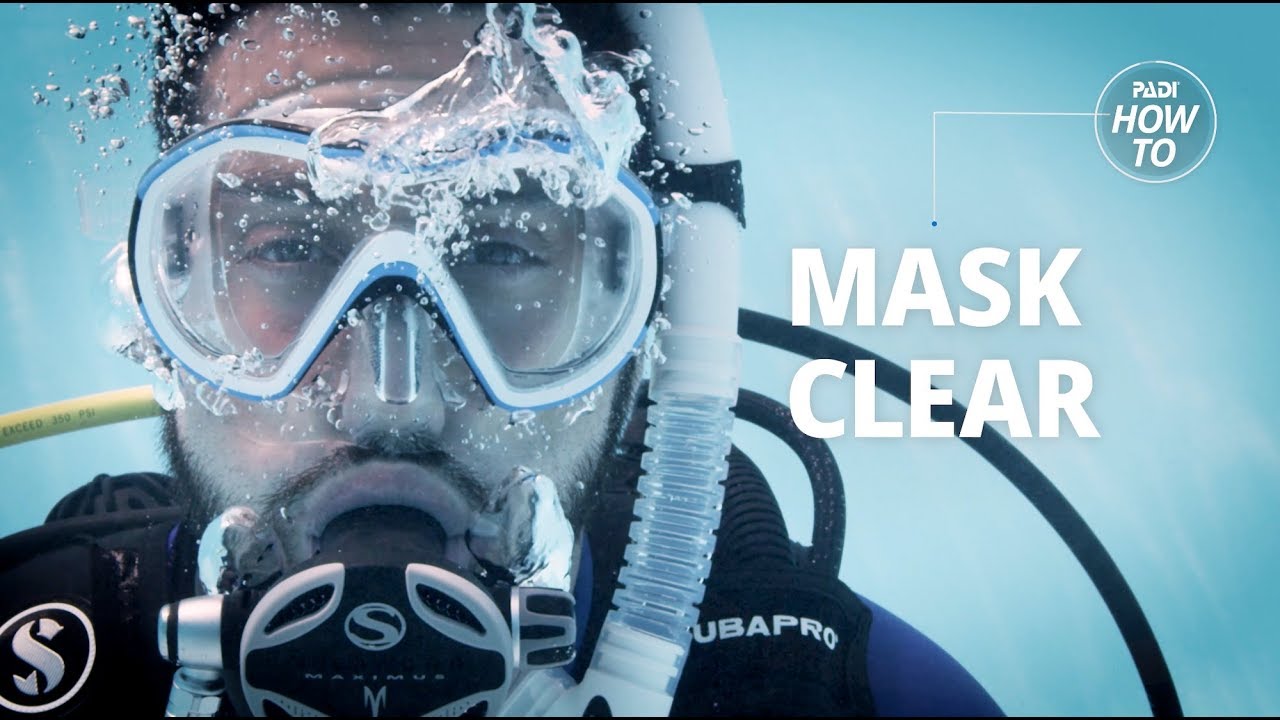
- Once the mask is set, pull the strap over your head, making sure it is not twisted. To clear the water inside your mask, press the top of the mask frame against your forehead, tilt your head back slightly, look up and exhale a long, steady breath through your nose. This technique will push all of the water out through the bottom of your mask, and, voila, you are back in business!
Click to display the embedded YouTube video
Step 5: From Student to Explorer
The mask removal and replacement skill is often the final hurdle before a diver feels truly comfortable in the water. Realizing it’s possible to remain both calm and capable underwater, even when vision is temporarily obscured, results in a substantial boost to diver confidence. This confidence is what allows us to “Seek Adventure” responsibly. When we are calm, our buoyancy is better, our air lasts longer and we become better guardians of the underwater world.
Ready for your first breath underwater? The mask removal and replacement skill is just one small step toward a lifetime of incredible ocean experiences. If you haven’t started your PADI Open Water Diver course yet, join the global community of divers today.