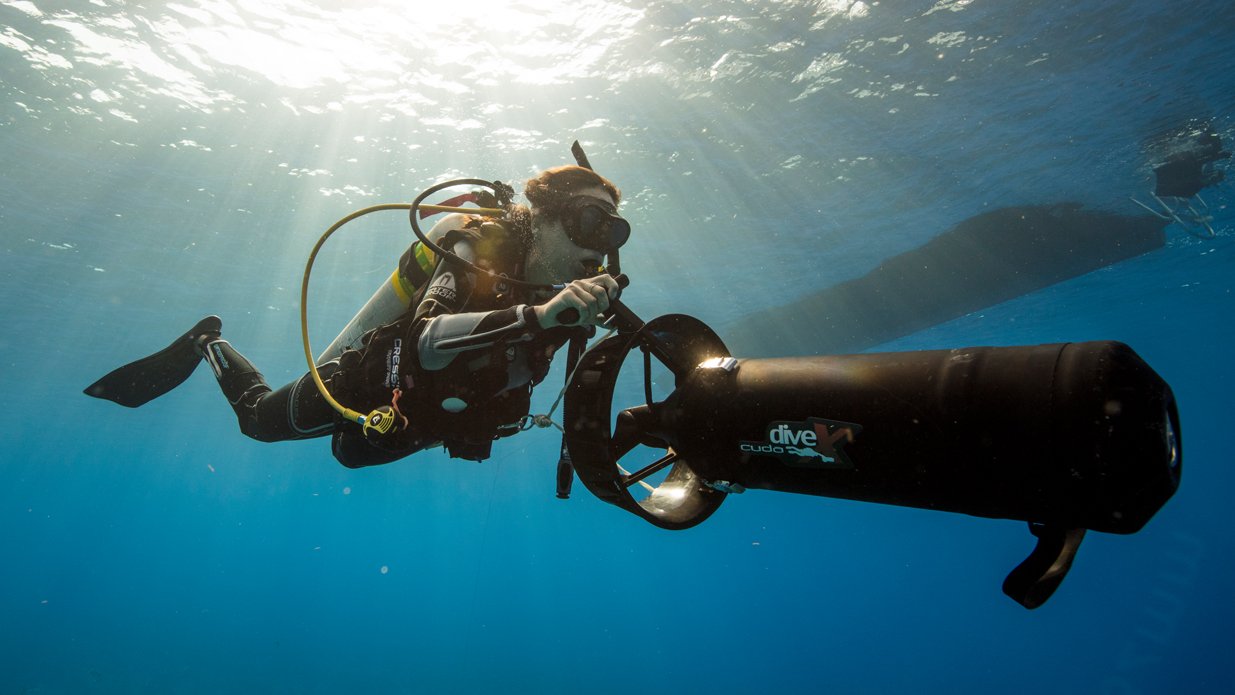
Imagine a dive light that has the high power, long burn time and dependability demanded by cave divers, yet is not much larger than a magic marker. Or, how about a DPV (Diver Propulsion Vehicle) that zooms you over coral reefs or through kelp forests at about 10 kph/6 mph (that’s fast for a DPV), yet is so small and light that out of water, you can carry it with one hand? Either one goes more than a day on a single charge, yet recharges in 10 minutes. And on that note, imagine a dive watch or dive computer that you never have to recharge – in fact, you could pass it down to your grandchildren still working.
Sound far-fetched? If you follow battery technology trends, innovations like these are not only possible but could be emerging in the next few years. This is significant not just for diving, of course, but for society overall, with better energy use and helping shift to greener, sustainable energy sources.
Batteries and Diving
While most of us don’t first think of batteries when it comes to dive gear, they’ve been part of our sport since its birth, most evident in dive lights. Commercial dive lights were widely available by the late 1960s and early 1970s, including heavy coffee-can-sized lights that used up to 10 D cells, or lantern batteries, with the first rechargeable NiCad dive lights emerging in the mid 1970s. (Look here for more about early dive lights.) Cave divers needed more powerful, longer-burning lights, so they started by improvising with motorcycle wet cell batteries, resulting in lights with huge butt or side-mounted battery canisters and cable-tethered heads – good for two or three hours at most. Early DPVs were huge, largely due to the big batteries needed, yet after one dive, you needed to recharge them. Even the Edge, the first commercially successful dive computer in 1983, used batteries so fast that it had a special procedure for installing new ones between dives without losing its memory.

New Solutions
Thanks to battery and electronic technology innovations, over the years our gear has improved so it uses less power while doing more. In addition, batteries hold more juice, so we now have more performance in smaller packages. Today’s lithium and nickel-metal hydride batteries, coupled with modern electronics, serve us well, which is especially noticeable in compact, modern LED cave diving lights that have five-hour-plus burn times. Modern imaging lights reflect the same improvements, and today, excepting the highest-end video models, you don’t have to open a camera housing between dives to change batteries.
But challenges remain:
- Batteries don’t always hold the desired power for the intended use.
- Batteries wear out and need to be replaced, which can be costly.
- Recharging batteries has risk – something the Conception tragedy reminded us of.
- Recharging time is often impractically long.
- Some batteries use minerals that are expensive and/or are damaging to the environment.
Fortunately, new battery types are tackling these head-on. There are many types emerging, but some of the most noteworthy include:
Sodium-Ion Batteries. These use sodium instead of lithium, which is better for the environment, significantly less expensive and gives batteries a substantially longer life. While they’re heavier, these are good choices for large power storage for wind/solar/tidal renewable energy generation – something I imagine every Ocean Torchbearer supports.
Lithium Iron Phosphate, Lithium Sulfur Batteries. These replace cobalt and nickel with iron and phosphate (or sulfur), both of which are more cost-effective and give the batteries a longer lifespan. This reduces the cost of EVs to help trend away from fossil-fueled vehicles, as well as reduces the need for lithium and cobalt, both of which have significant environmental impact during mining.
Solid-State Batteries. The ‘holy grail’ of innovations, by replacing gels and liquids with solid materials, solid state batteries promise to be cheaper, hold more power, charge substantially faster and have almost no fire risk. Besides being difficult to manufacture, their main downside is poorer low-temperature performance.
Silicon Anode Batteries. Putting silicon in the anode (battery part that releases electrons) gives batteries more power storage and very fast charging times. Their main downside is that the batteries may have a shorter useful lifespan.
Nuclear-Diamond Batteries. Looking farther into the future and sounding almost sci-fi, nuclear-diamond batteries could run low-power electronics (which could include personal devices like watches and dive computers) for centuries. These batteries do so by harnessing the natural, but slow, power of carbon-14 breakdown – meaning a device could remain powered for hundreds of years (assuming the rest of the gadget can endure that long)!
There’s a lot happening with battery technologies, so look here, here and here if you want to learn more, and be sure to visit your PADI Dive Center or Resort as we see them make their way into the latest dive gear.
The bottom line is that as divers, battery innovations will make dive electronics, as well as those in our everyday lives, more useful and compact (where needed). As Ocean Torchbearers, we can look for the same innovations to help society use electrical power better, reducing reliance on fossil fuels, and at the same time, using battery materials that are more environmentally friendly – all important improvements no matter how you look at it.
Seek adventure. Save the ocean.
Dr. Drew Richardson
PADI President & CEO
PS: Important Reminder – Because some types of batteries have fire risk, for your safety and the safety of those around you, please handle and use batteries responsibly according to airline, boat and manufacturer policies. These usually include not putting some types in checked baggage, monitoring during charging and using only manufacturer designated chargers.